

The Strategic Value of General Business Services
In the dynamic landscape of October 2026, businesses are constantly seeking an edge, a way to streamline operations, reduce overheads, and focus on their core competencies. This is where general business services emerge as a cornerstone of modern operational strategy. These services, often provided by external partners, offer a multifaceted approach to achieving operational alignment, ensuring that every component of an organization works synergistically towards overarching goals. By offloading non-core yet critical functions, businesses can achieve significant cost management, transforming fixed costs into variable ones and benefiting from economies of scale.
The inherent flexibility of these services also champions scalability. Whether a business is experiencing rapid growth or navigating market fluctuations, general business services can adjust their support levels accordingly, preventing the need for costly internal restructuring or underutilized resources. This dynamic adaptability is crucial for resource optimization, allowing companies to allocate their internal talent and capital to strategic initiatives that directly impact innovation and market leadership.
Moreover, by entrusting specialized functions to experts, organizations can significantly reduce various forms of risk reduction, from compliance failures to operational inefficiencies. Finally, the integration of advanced tools and methodologies often leads to robust workflow automation, freeing up valuable human capital from repetitive tasks and enabling them to engage in more analytical and creative endeavors.
To illustrate the strategic choice between managing administrative functions internally versus leveraging external expertise, consider the following comparison:
Feature In-House Administration External Service Model Cost Structure High fixed costs (salaries, benefits, infrastructure) Variable costs, often lower due to economies of scale Expertise Dependent on internal hiring and training Access to specialized, up-to-date knowledge and tools Flexibility Limited, difficult to scale up or down quickly Highly adaptable to changing business needs and volumes Control Direct oversight, but also direct responsibility Defined by service level agreements, shared responsibility Focus Diverts internal resources from core activities.
Allows internal teams to concentrate on strategic goals Technology Requires internal investment and maintenance Leverages provider’s advanced technology and infrastructure. This table highlights how external service models can offer a more agile, cost-effective, and expert-driven solution for many enterprises, particularly those aiming for rapid growth or operating in volatile markets.
Core Functions of General Business Services
The scope of general business services is broad, encompassing a range of functions vital for any organization’s smooth operation. At its foundation is administrative support, which includes everything from managing schedules and correspondence to data entry and office management. These seemingly mundane tasks are the gears that keep the business running, and their efficient handling is paramount.
Beyond daily administration, robust financial reporting is indispensable. This involves meticulous bookkeeping, accurate payroll processing, expense tracking, and ensuring adherence to financial regulations. Precise financial data not only supports sound decision-making but also maintains transparency and compliance.
Effective document management is critical. This function ensures that all company records—contracts, policies, client information, and intellectual property—are securely stored, easily retrievable, and properly version-controlled. It safeguards against data loss and streamlines information access, fostering efficiency and security.
Compliance tracking is another core function, navigating the complex web of industry-specific regulations, labor laws, and data privacy mandates. Staying compliant is not just about avoiding penalties; it’s about building trust and maintaining a reputable standing in the market.
Finally, talent coordination plays a significant role, especially for growing businesses. This involves supporting human resources functions, from assisting with recruitment and onboarding new employees to managing employee records and facilitating training programs. By ensuring that the right talent is in the right place, these services contribute directly to productivity and organizational success.
Optimizing Workflows Through General Business Services
Optimizing workflows is about more than just speeding things up; it’s about making processes smarter, more efficient, and more resilient. General business services are instrumental in this transformation, often beginning with comprehensive process mapping. This involves visually charting existing workflows, identifying every step, decision point, and hand-off. This detailed analysis reveals bottlenecks, redundancies, and areas ripe for improvement, providing a clear roadmap for optimization.
Once processes are understood, the next step is often task automation. Repetitive, rule-based tasks that consume valuable employee time can be automated using specialized software or robotic process automation (RPA). This not only accelerates execution but also minimizes human error, leading to greater consistency and accuracy. For instance, automated invoice processing or data synchronization can free up finance teams to focus on strategic analysis rather than manual data entry.
In today’s interconnected business environment, cloud collaboration platforms are essential. These tools enable teams, whether co-located or dispersed, to work together seamlessly on documents, projects, and communications. Cloud-based solutions facilitate real-time updates, shared access to resources, and streamlined communication, breaking down silos and fostering a more integrated work environment.
To ensure that optimization efforts are genuinely impactful, performance metrics must be established and continuously monitored. Key Performance Indicators (KPIs) related to efficiency, accuracy, and resource utilization provide objective data on the effectiveness of new workflows. Regular review of these metrics allows for ongoing adjustments and continuous improvement, ensuring that the business remains agile and responsive. For organizations seeking to implement these sophisticated strategies and enhance their operational efficiency, engaging professional business services can provide the necessary expertise and resources. These external partners specialize in identifying opportunities for improvement and deploying solutions tailored to specific business needs, driving greater productivity and strategic advantage.
Essential Operational Frameworks for Growing Enterprises
For enterprises poised for or experiencing growth, establishing robust operational frameworks is not merely beneficial; it is foundational. These frameworks provide the structure and guidance necessary to manage increasing complexity, maintain quality, and ensure sustainable expansion. A critical element involves meticulous resource planning, which is the strategic allocation and management of all available assets—human capital, financial resources, technological infrastructure, and intellectual property. This foresight prevents bottlenecks and ensures that growth is supported by adequate capacity.
Another vital component is cross-functional coordination. As businesses expand, departments can become siloed, hindering information flow and collaborative efforts. Effective frameworks foster seamless interaction between different teams, ensuring that projects are executed efficiently and that departmental goals align with overall business objectives. This often requires clear communication protocols, establishing standardized channels and methods for information exchange, decision-making, and feedback. Without these protocols, miscommunication can lead to errors, delays, and a fragmented organizational culture.
Finally, integrating comprehensive quality assurance mechanisms throughout all operations is paramount. This involves setting clear standards for products, services, and internal processes, and then consistently monitoring and measuring performance against these benchmarks. Quality assurance not only protects brand reputation but also drives customer satisfaction and reduces the costs associated with errors and rework.
Technology Adoption and Systems Integration
In October 2026, the strategic adoption of technology is no longer optional but a competitive imperative. For growing enterprises, this begins with embracing modern cloud infrastructure. Moving away from on-premise servers to cloud-based solutions offers unparalleled flexibility, scalability, and cost-efficiency. Cloud platforms enable businesses to rapidly deploy new applications, store vast amounts of data securely, and access resources from anywhere, supporting remote workforces and global operations. This agility is crucial for adapting to market changes and scaling operations without significant capital expenditure.
Complementing cloud infrastructure is the strategic implementation of enterprise software. This includes comprehensive Enterprise Resource Planning (ERP) systems that integrate various business functions like finance, HR, manufacturing, and supply chain management. Customer Relationship Management (CRM) platforms are vital for managing client interactions and sales pipelines, while advanced project management tools ensure efficient execution of initiatives. These systems centralize data and processes, providing a holistic view of the business and enabling data-driven decision-making.
However, the benefits of technology can only be fully realized if robust data security measures are in place. With increasing cyber threats and stringent data privacy regulations (like GDPR and CCPA), protecting sensitive information is paramount. This involves implementing advanced encryption, multi-factor authentication, regular security audits, and employee training to prevent breaches and maintain customer trust. A single data breach can have devastating financial and reputational consequences.
The goal of technology adoption is workflow centralization. This means integrating disparate systems and processes into a cohesive, unified platform. When all business functions operate within interconnected systems, information flows freely, reducing manual data entry, eliminating redundancies, and improving overall operational efficiency. This centralization provides a single source of truth for critical business data, enabling more accurate reporting and faster, more informed strategic responses.
Scalability and Strategic Resource Allocation
The ability to scale efficiently is a hallmark of successful growing enterprises. Capacity planning is the proactive process of assessing future demands and ensuring that the organization has the necessary resources—people, technology, and infrastructure—to meet them. This involves forecasting sales, analyzing market trends, and understanding the potential impact of new products or services. By anticipating needs, businesses can avoid being caught off guard by rapid growth or unexpected demand surges.
Integral to capacity planning is budget forecasting. This involves projecting future financial needs and allocating capital strategically to support growth initiatives. Accurate budget forecasting ensures that funds are available for investments in technology, talent acquisition, and market expansion, while also maintaining financial stability. It’s a delicate balance between investing for the future and managing current expenditures responsibly.
Effective task delegation is another critical aspect of scalability. As an enterprise grows, leadership must empower teams and individuals by clearly assigning responsibilities and providing them with the autonomy and resources to succeed. This not only optimizes workload distribution but also fosters employee development and engagement. Micro-management becomes a significant bottleneck in a scaling organization, making effective delegation indispensable.
Finally, establishing productivity benchmarks provides a quantitative measure of efficiency and effectiveness across the organization. These benchmarks, whether related to sales conversion rates, project completion times, or customer service response times, allow businesses to track performance, identify areas for improvement, and ensure that resources are being utilized optimally. Regular review and adjustment of these benchmarks are key to driving continuous improvement and sustaining growth.
Navigating Modern Organizational Challenges
The path to sustained enterprise growth is rarely smooth; it’s often fraught with complex organizational challenges that demand strategic foresight and agile responses. In October 2026, businesses grapple with a rapidly shifting landscape, necessitating robust strategies for change management. This involves guiding employees through transitions, whether technological, structural, or cultural, minimizing disruption and fostering acceptance. Without effective change management, resistance can derail even the most well-conceived initiatives.
Equally challenging is keeping pace with evolving regulatory compliance. Governments and industry bodies continually introduce new laws and standards, particularly concerning data privacy, environmental impact, and labor practices. Non-compliance can lead to hefty fines, legal battles, and severe reputational damage. Therefore, organizations must implement proactive systems to monitor, interpret, and adapt to these changes.
The nature of work itself is transforming, requiring businesses to embrace workforce flexibility. The rise of remote work, hybrid models, and the gig economy means that traditional employment structures are no longer universally applicable. Enterprises must develop policies and technologies that support diverse work arrangements, ensuring productivity, collaboration, and employee well-being across varied settings.
Furthermore, as businesses increasingly rely on external partners for specialized services, effective vendor oversight becomes paramount. Managing relationships with suppliers, contractors, and service providers involves ensuring they meet contractual obligations, adhere to quality standards, and align with the company’s values and security protocols. Poor vendor management can introduce significant risks and compromise operational integrity.
To better understand the systematic approach required for large-scale transitions, consider the various stages involved in enterprise change management:
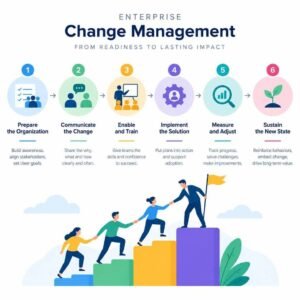
This infographic illustrates the structured process that organizations must follow to successfully implement significant changes, from preparing the organization to sustaining the new state.
Risk Mitigation and Compliance Management
In an era of increasing complexity and interconnectedness, effective risk mitigation and compliance management are non-negotiable for enterprise stability and growth. A cornerstone of this is conducting regular internal audits. These systematic evaluations of an organization’s internal controls, accounting processes, and operational procedures help identify weaknesses, inefficiencies, and non-compliance issues before they escalate into major problems. Proactive auditing ensures that policies are being followed and that the business operates within established guidelines.
Beyond internal checks, every enterprise needs a robust business continuity plan. This involves developing strategies and procedures to ensure that critical business functions can continue during and after a disruptive event, such as a natural disaster, cyberattack, or pandemic. A well-crafted plan minimizes downtime, protects assets, and safeguards customer trust, proving invaluable when unforeseen circumstances arise.
With the proliferation of data, data governance has become a critical discipline. This involves establishing clear policies, procedures, and responsibilities for the collection, storage, processing, and disposal of data. Effective data governance ensures data quality, security, and compliance with privacy regulations, helping to prevent breaches and maintain the integrity of information assets. It’s about treating data as a valuable organizational asset that requires careful stewardship.
Finally, meticulous contractual compliance is essential. Every business enters into numerous agreements—with customers, suppliers, employees, and partners. Ensuring that all parties adhere to the terms and conditions of these contracts is vital for protecting legal rights, managing financial obligations, and maintaining healthy business relationships. This requires robust contract management systems and processes to track obligations, deadlines, and deliverables.
Enhancing Service Delivery and Client Satisfaction
In today’s competitive market, exceptional service delivery and client satisfaction are powerful differentiators. Enterprises must move beyond simply meeting expectations to actively exceeding them. This begins with establishing effective feedback loops. Regularly soliciting, collecting, and analyzing client feedback through surveys, direct communication, and social listening provides invaluable insights into their needs, pain points, and perceptions. Acting on this feedback demonstrates responsiveness and a commitment to continuous improvement, strengthening client relationships.
To ensure that service delivery remains consistently high, businesses should establish clear service benchmarks. These are measurable standards that define the expected level of performance for various services, such as response times, resolution rates, and product quality. Benchmarking against industry leaders or internal best practices provides a target for excellence and helps identify areas where improvements are needed. Regular reporting on these benchmarks keeps teams accountable and focused on delivering value.
Quality control is an overarching principle that applies across all aspects of service delivery. It involves implementing processes and procedures to monitor and maintain the quality of products and services, ensuring they consistently meet or exceed established standards. From the initial design phase to post-delivery support, rigorous quality control prevents defects, reduces rework, and ultimately enhances the client experience. It’s about building quality into every step of the process, rather than just inspecting for it at the end.
Finally, transparent and proactive client communication is paramount. Keeping clients informed about project progress, potential issues, and upcoming developments builds trust and manages expectations. Clear, concise, and timely communication prevents misunderstandings, resolves concerns quickly, and fosters a collaborative partnership. In an era where information is readily available, clients expect to be kept in the loop, and businesses that excel at communication often see higher rates of client retention and satisfaction.
Frequently Asked Questions About Business Solutions
Navigating the complexities of modern business solutions often brings forth a range of questions, particularly for enterprises considering significant operational shifts. Common inquiries revolve around the practicalities of operational strategy, the financial implications of implementation costs, and the long-term viability of service scalability. Addressing these questions upfront can help businesses make informed decisions and build confidence in their chosen path.
How do general business services impact operational efficiency?
General business services significantly impact operational efficiency by systematically addressing common inefficiencies within an organization. One primary way is through bottleneck removal. By analyzing existing workflows, these services identify constraints or choke points that slow down overall operations. Once identified, strategies are implemented to eliminate or mitigate these bottlenecks, ensuring a smoother and faster flow of work.
Another key impact is task streamlining. Many internal processes accumulate unnecessary steps or redundancies over time. General business services specialize in re-engineering these processes, simplifying them to their most essential components. This reduces the time and resources required to complete tasks, leading to faster turnaround times and higher output.
Effective cost containment is also a direct outcome. By optimizing workflows and automating tasks, businesses can reduce operational expenses associated with labor, materials, and technology. External service providers often leverage specialized tools and expertise that would be too costly for individual businesses to acquire and maintain in-house, leading to overall cost savings.
Perhaps most importantly, these services enable focus delegation. By taking over non-core administrative, financial, or compliance tasks, general business services free up internal teams to concentrate on strategic initiatives that directly drive growth and innovation. This allows highly skilled employees to dedicate their time to high-value activities, rather than being bogged down by routine operational duties. This strategic reallocation of internal focus is crucial for competitive advantage.
What criteria should guide the selection of operational service models?
Choosing the right operational service model is a critical decision that can profoundly impact a business’s future. Several key criteria should guide this selection process. Foremost among these is scalability. The chosen model must be able to adapt to fluctuating business volumes, whether that means rapidly expanding to meet increased demand or efficiently downsizing during leaner periods, without incurring prohibitive costs or disruptions. A scalable solution ensures that operations can grow in tandem with the enterprise.
Technical compatibility is another non-negotiable criterion. Any new service model or solution must integrate seamlessly with existing IT infrastructure and software. Compatibility issues can lead to costly delays, data silos, and operational inefficiencies. Therefore, thorough due diligence on integration capabilities is essential to avoid future headaches.
The service reliability of the provider is paramount. Businesses need partners they can trust to deliver consistent, high-quality service without interruption. This involves evaluating a provider’s track record, service level agreements (SLAs), disaster recovery plans, and customer support responsiveness. Unreliable service can jeopardize critical business functions and damage client relationships.
Finally, the chosen model must demonstrate a strong strategic fit with the enterprise’s long-term goals and organizational culture. It should align with the company’s vision, values, and operational philosophy. A service model that is technically sound but culturally misaligned may face internal resistance and fail to deliver its full potential. Evaluating this strategic fit ensures that the partnership is not just functional, but also synergistic.
How do modern business solutions facilitate enterprise growth?
Modern business solutions are powerful catalysts for enterprise growth, enabling organizations to expand their reach, optimize their operations, and respond with agility to market changes. One significant way they facilitate growth is through supporting market expansion. Advanced analytics tools can identify new market opportunities, while integrated CRM systems can manage new client acquisition and relationships across diverse geographies. Cloud-based platforms allow businesses to operate globally without needing physical infrastructure in every location, significantly lowering barriers to entry.
They also provide crucial infrastructure flexibility. Unlike traditional, rigid systems, modern solutions are designed to be adaptable. Cloud services, for instance, can be scaled up or down instantly, providing the computing power and storage needed for growth spurts or new projects without massive upfront investments. This flexibility ensures that technology infrastructure never becomes a bottleneck to expansion.
Furthermore, these solutions enable intelligent resource reallocation. By automating routine tasks and providing clear performance metrics, businesses can identify where human and financial resources are being underutilized or misdirected. This allows for strategic redeployment of talent and capital to high-impact areas, such as research and development, marketing campaigns for new products, or enhanced customer service initiatives, maximizing their contribution to growth.
Modern business solutions foster strategic agility. In today’s environment, the ability to quickly pivot, adapt to new trends, and seize opportunities is vital. Integrated data platforms provide real-time insights, allowing decision-makers to react swiftly to market shifts, competitive threats, or emerging customer needs. This responsiveness, powered by robust solutions, transforms potential challenges into pathways for sustained growth and innovation.

Conclusion
As we look towards the future from October 2026, it is clear that the pursuit of operational excellence is a continuous journey, not a destination. The insights gleaned from exploring modern business solutions underscore their indispensable role in fostering sustainable growth for enterprises of all sizes. By strategically leveraging general business services, organizations can achieve unparalleled operational alignment, optimize resource utilization, and significantly mitigate risks, laying a robust foundation for expansion.
The adoption of essential operational frameworks, characterized by intelligent technology integration, meticulous capacity planning, and proactive risk management, equips businesses to navigate the inherent complexities of a dynamic market. These frameworks empower enterprises to not only withstand challenges but to transform them into opportunities for innovation and competitive advantage.
The success of any modern business hinges on its commitment to continuous improvement and strategic execution. By embracing these principles and thoughtfully applying the solutions discussed, organizations can enhance service delivery, elevate client satisfaction, and ensure that every operational facet contributes to a cohesive, agile, and resilient enterprise. The future belongs to those who are prepared to evolve, optimize, and execute with precision.